The biological mechanism of a vampire
I Am LegendVampire biology is the explanatory system Robert Neville builds from observation, reading, and experiments on the dead. It replaces inherited vampire folklore with a material account centered on the vampiris bacillus: the infection alters circulation, metabolism, teeth, tissue repair, and behavior, while also making the vampire dependent on fresh blood. The theory does not merely classify the creatures; it converts their recurring appearances, odors, wounds, comas, and deaths into evidence in a scientific investigation.
From Superstition to Physiology
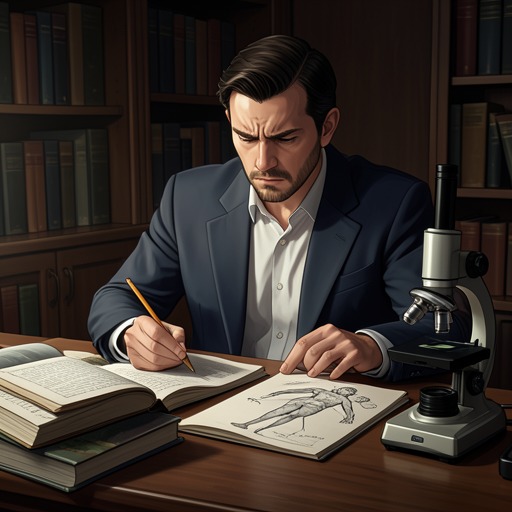
Robert Neville begins by treating vampirism as a problem that can be tested against anatomy. His reading of the lymphatic system supplies the first major link. Blood plasma, along with red and colorless cells, escapes through capillary walls into surrounding tissue and is returned through lymphatic vessels. Lymph nodes filter solid waste from this returning fluid. Breathing helps drive the circulation by compressing the abdominal contents, while physical movement makes skeletal muscles compress the lymph vessels; valves prevent the flow from backing up.
The dead vampires, however, do not breathe. Robert Neville therefore reasons that roughly half of their lymphatic flow is absent, leaving a considerable quantity of waste products in their bodies. This physiological blockage offers an explanation for the fetid odor associated with the vampire. The smell is not simply a mark of supernatural corruption but a consequence of an altered body unable to process and remove waste normally.
The same investigation connects vampirism with the transmission of disease. Robert Neville encounters the medical observation that flies and mosquitoes can mechanically disseminate many bacterial diseases of humans. The mosquito that Ruth identifies and that Robert Neville crushes becomes part of the wider infection ecology: insects can carry disease between bodies, while the vampiric condition itself is understood through bacterial action rather than through legend alone.
The Vampiris Bacillus and Blood Dependence
Robert Neville’s decisive hypothesis is that the vampire is governed by a bacillus whose survival depends on access to blood. When the vampire receives fresh blood, the organism and its host form a mutually sustaining system. The bacillus supplies energy that enables the vampire to obtain more blood, while the vampire feeds the bacillus. In this account, blood-feeding is not merely a ritual appetite or a symbolic expression of evil; it is the metabolic constraint that keeps the infected body active.
The bacillus is described as a facultative saprophyte, capable of living with or without oxygen but behaving differently under those conditions. Inside the vampire’s system it is anaerobic and establishes a symbiosis with the host. The infection also causes the growth of the canine teeth, giving a physiological basis to one of the most recognizable features of vampire tradition.
The blood requirement explains what happens when nourishment is withdrawn. Under unfavorable conditions, certain bacilli condense their contents into thick-walled spores, detach from their original cells, and remain resistant until conditions again support survival. Robert Neville applies this process to vampirism: without blood, the vampiris bacillus sporulates and the vampire sinks into a coma. When favorable conditions return, the body can rise again, apparently unchanged.
Starvation can also produce a more destructive result. Bacteria that are not properly fed may metabolize abnormally and produce bacteriophages, inanimate self-reproducing proteins that destroy the bacteria. Robert Neville infers that, when no blood enters, the bacilli absorb water, swell, and eventually explode, destroying the cells around them. Sporulation and cellular destruction thus provide two related explanations for the vampire’s altered states: the organism can protect itself by entering dormancy, or the failed metabolism can turn against the host.
Oxygen, Tissue Repair, and the Limits of Bullets
Robert Neville’s experiments reveal why ordinary gunfire is ineffective. The bacilli cause the infected body to produce a powerful glue that seals bullet openings almost as soon as they are made. Bullets are enclosed nearly immediately, and the wound closes before the projectile can penetrate more than a few fractions of an inch. The body can contain an almost indefinite number of bullets because this glue prevents meaningful penetration. Shooting a vampire is therefore compared to throwing pebbles into tar: the weapon strikes the surface but does not disrupt the organism.
This mechanism also revises the traditional staking rule. The stake does not kill because the heart is a uniquely magical center, but because it opens the body and admits air. Robert Neville explains that a deep cut at the wrists can serve the same purpose if it prevents the body glue from sealing the wound. Once oxygen enters, the bacillus changes instantaneously from an anaerobic symbiont into a virulently parasitic organism. It begins to consume the host, so the infected flesh can no longer maintain itself.
The explanation accounts for rapid decomposition as well. A woman who had been dead for a long time broke down quickly once air reached her system, because the altered germs caused spontaneous dissolution. The stake and the deep wrist cuts are therefore practical ways of forcing the infection into its destructive aerobic phase. What folklore presents as a ritual gesture becomes, in Robert Neville’s reconstruction, a method of manipulating the bacillus’s environmental conditions.
Bodies, Behavior, and Observation
Vampire biology is never isolated from the visible and audible routines of the creatures. Robert Neville has watched the vampires gather outside his house and has learned to treat their repeated cries and provocations as behavioral evidence. At first he observes them through a peephole, but the women notice him and strike vile, enticing postures in an attempt to draw him outside. He eventually refuses to look at them, not because their presence has become less dangerous, but because the spectacle itself has become a form of psychological pressure.
The peephole reverses its function when Ben Cortman comes onto the lawn. Robert Neville watches him arrive and mutters an invitation that Ben Cortman echoes loudly. The exchange is a ritualized encounter between observer and observed, but it also shows that the vampires can organize their presence around his habits and his defensive enclosure. The house becomes both laboratory and fortress: Robert Neville studies the infected from concealment while the infected repeatedly test the boundaries of his isolation.
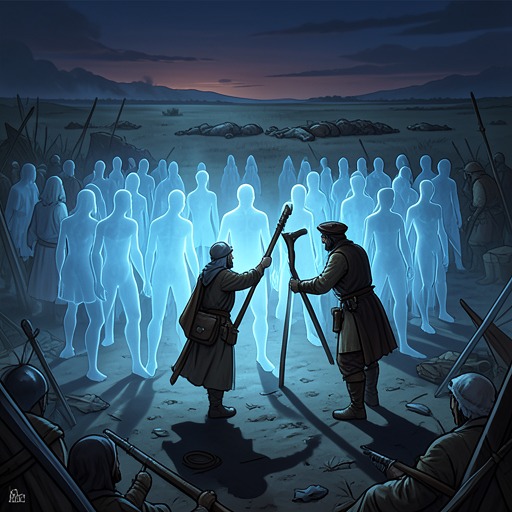
His observations extend to the vampires’ vulnerability to illumination. When the new society arrives at night with dark cars, guns, axes, pikes, and sweeping spotlights, the beams strike their bloodless faces and make them whirl away from the blinding light. The scene confirms that the vampire body’s relation to light is not merely a story inherited from superstition; it has practical force in the creatures’ movement and in the tactics used to expose them.
The biology also complicates the boundary between human and nonhuman infection. A dog briefly becomes a possible companion for Robert Neville, but its dulled eyes and sickness reveal that it too has been affected. Robert Neville comforts it, touches its warm neck, and promises recovery while the animal licks his palm; the dog dies a week later. His grief shows that the infection is not only a human catastrophe and that the scientific category of vampirism does not erase the emotional significance of an individual body.
Significance and Consequences
Robert Neville’s biological model gives him a method for converting terror into knowledge. The creatures’ odor, blood hunger, comas, bullet resistance, teeth, wounds, and decomposition become connected effects of one infectious system. His experiments also explain why the old methods sometimes work and sometimes fail, allowing him to replace repeated guesswork with targeted intervention.
Yet the theory does not restore the social world that produced it. Robert Neville can understand the organisms while remaining surrounded by them, and his knowledge does not prevent the new society from observing, surrounding, and capturing him. The final reversal is therefore epistemic as well as political: the man who has spent years studying vampires from behind a peephole is himself discovered inside a barred cubicle after the attack on his house. Vampire biology has made him the investigator of the old order, but the new order’s control of visibility and confinement places his own body under examination.
The concept consequently carries an irony. Scientific explanation displaces supernatural mystery, but it does not guarantee moral authority or survival. Robert Neville’s account is powerful because it identifies mechanisms, yet the infected bodies remain bound to blood, decay, and violent social change. His biology explains how the vampires live and die; it cannot decide which population will finally be recognized as normal, or whether the last human investigator will be permitted to remain part of the world he has explained.